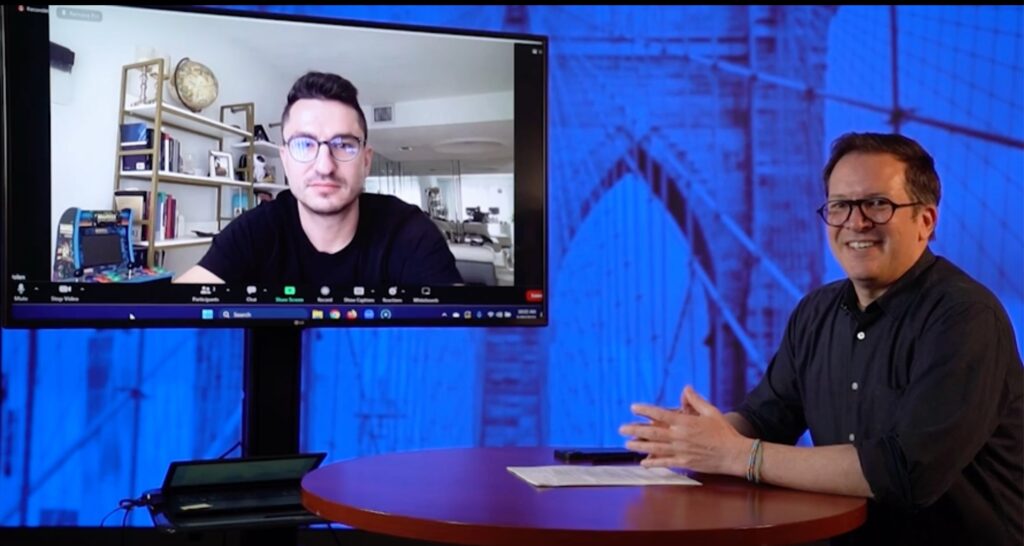
Directing a Hybrid Studio Interview for an Online Blockchain Course

Prof. Kangas (on right) interviews Volen Tsolov (on left) for IS 325 Intro to Blockchain

Overview

In this project, I served as a technical director/director of photography for a guest lecture video in an introductory blockchain course. The faculty member, Professor Chris Kangas, had arranged a series of expert interviews, including one with Volen Tsolov (Mastercard), who joined remotely. The challenge was to create a polished, high‑quality interview despite the constraints of virtual participation and a limited production window. To achieve this, our media team designed a hybrid setup that blended live studio filming with real‑time Zoom participation, giving the conversation the feel of an in‑person exchange.

Skills Gained

I coordinated a multi‑camera studio shoot, directed the media team, and managed a complex hybrid recording environment. I tested various lighting and camera configurations, refined Zoom recording settings, and led rehearsals to ensure the technical and aesthetic consistency. I collaborated closely with the Media Team. Sharon Jorrin ran our audio and did much of the editing. Fallon Saratovsky ran second camera and the Zoom, she also developed graphics and titles for the series. Through this process, I learned to anticipate technical failures, adapt quickly, and make clear decisions under time pressure. An “aha” moment occurred to me during this process. By positioning Volen’s Zoom feed on a large rolling monitor, it transformed the visual narrative, allowing us to simulate a conversational presence that felt natural and engaging.

Impact

This video filled a key instructional need by bringing contemporary industry perspectives into an asynchronous undergraduate data science course. Blockchain careers evolve quickly, and hearing directly from practitioners helps students connect theory to real‑world applications. The final product has remained in active use for several years, and feedback from Prof. Kangas has been consistently positive. The project demonstrated our team’s ability to innovate within the constraints of online education, and it strengthened OFDIT’s capacity to produce media that enhances student engagement and faculty vision.


Crafting an Engaging Course Overview for Managerial Accounting and Finance

Opening video title "Welcome to BUS 306 Managerial Accounting and Finance." A collage of images in a circle; business meeting, shopping, pizza.
BUS 306 Course Overview opening title slide

Overview

For this project, I produced a two‑minute Course Overview video for BUS 306, a seven‑week online course in CUNY SPS’s Online Business program. My role was to guide the course developer, Professor Joseph Foy, through the scripting and production process. My approach was to help Prof. Foy shape the video into a concise and motivating “film trailer” for the course. A small challenge emerged when reading the first draft of the script. Prof. Foy used a Gen AI tool which created an unusual script format. Although well‑intentioned, this small deviation from past productions reinforced a key lesson: a strong video rests on a clear, focused script. The Gen AI version included several extra instructions and production notes, which needed to be removed in order to focus on delivering a clear, focused script.

Skills Gained

I worked with Prof. Foy to refine the script so it aligned with the video’s core purpose, and, as always, kept all design choices within Mayer’s 12 Multimedia Learning Principles. I cleaned and enhanced audio using Adobe tools, built visual sequences in a consistent template, and integrated context‑appropriate still images and stock footage. I revisited the first script that included the AI‑generated visual suggestions. This prompted an “a‑ha” moment: AI tools can give you ideas quickly, but you still need human judgment to make everything fit together. Throughout the project, I collaborated closely with Prof. Foy, incorporating feedback, and translating ideas into a polished, student‑ready resource.

Impact

This Course Overview addresses a persistent need in online learning: orienting students quickly and sparking early engagement. By framing the course around the experiential “Pizza Place Project,” the video helps students grasp not only what they will do, but why it matters. At time of writing, the video has yet to be seen by students in BUS 306, but Prof. Foy and other colleagues have praised the final product, noting its clarity, energy, and alignment with program goals. Once released, the video is expected to strengthen students’ first‑week experience and support OFDIT’s broader mission of elevating instructional quality across SPS.

Illustrating Excel’s IF Function Through Instructional Video Design

an animated gif of opening graphic animation
Video Excerpt: The Logic Behind the IF Function (no audio)

Overview

In this project, I collaborated with Professor Sandra Figueroa to clarify a concept that many CIS 101 students found confusing: the logic behind Excel’s IF function. My role began with instructional design, ensuring the script conveyed the concept with precision and simplicity. Although the technical content was straightforward, the challenge lay in helping novice learners grasp conditional logic. Through Prof. Figueroa’s expertise on the subject, we needed only a couple rounds of script review and discussion, we shaped an example that used a clear, everyday analogy to anchor the idea.

Skills Gained

I applied instructional design principles to refine the script, then shifted into media production—designing visual sequences in Prezi, creating simple animations, and editing audio and video components in Adobe Premiere. I used my understanding of multimedia learning to structure the narration and visuals so they reinforced one another without distraction. I also coordinated closely with Professor Figueroa throughout the process, adapting to her expectations and responding to the instructional needs of the course. The project sharpened my ability to translate abstract concepts into concrete visual experiences.

Impact

The final video addressed a clear pedagogical gap: students needed a more intuitive grasp of conditional logic before applying it in Excel. By pairing a relatable scenario with a structured visual explanation, the video improved comprehension and became a durable resource within the course. Positive feedback from colleagues and from Prof. Figueroa affirmed its clarity and instructional value. Its continued use over multiple semesters—well beyond the typical shelf-life for such media—demonstrates its effectiveness in supporting student learning at CUNY SPS.