Tag: academics

CUNY SPS CM Grad School Roundtable

On March 3rd, Dr. Sarah Ruth Jacobs hosted a roundtable for CUNY SPS CM students interested in graduate school. Below is the video, relevant timestamps, and transcript. Click here as well for a document pertaining to resources for applying to grad school!

Timestamps

4:52 Question 1: How should I begin to research graduate programs? How can I find out if a certain graduate degree will likely lead to a job?

12:40 Question 2: Can I go to grad school while working full- or part-time? How can I find grad programs that might give me employment as part of the program?

18:51 Question 3: What should I be doing now to make myself a better candidate for grad school?

24:17 Question 4 : In practical terms, how much do a program’s reputation and alumni network shape long-term opportunity?

27:59 Question 5: How can I learn about what makes a grad school application successful, especially as a non-traditional student?

36:54 Question 6: Should I plan to attend grad school immediately after graduating from SPS or are there advantages to waiting?

41:53 Question 7: What does a typical timeline of applying to grad school look like? How many programs should I apply to?

45:14 Question 8: What kinds of graduate degrees students from SPS, and our program in particular, have done just to get a sense of, what is the landscape of possibility?

47:01 Question 9: I’m curious what your thoughts are on getting a master’s and job hirers considering you overqualified for a role. I’m pivoting into an adjacent field, but some would consider positions I’m researching entry-level. So is it dangerous to be overqualified?

51:39 Question 10 (paraphrased): Can I get scholarships or free tuition for grad school? 

55:16 Last Words of Wisdom 
Definitions and Misconceptions

Here you may find common student misconceptions as well as helpful definitions related to your time at SPS!

Definitions

Synchronous versus asynchronous

  • “Synchronous learning refers to instructors and students gathering at the same time and (virtual or physical) place and interacting in ‘real-time’. Online Synchronous courses resemble on-campus In-Person ones in that students must be (virtually) present at the same time. All required instructional hours are online.”
  • “Asynchronous learning refers to students accessing materials at their own pace and interacting with each other over longer periods. Online Asynchronous classes require all contact hours be held online asynchronously. Instruction takes place online asynchronously. The modality allows students to access materials and assignments on a flexible schedule in accordance with deadlines set by the professor.”

Prerequisites versus corequisites

  • “A prerequisite to a course is a requirement that must be completed before a student can enroll in that course.”
  • “A corequisite to a course is a requirement that must be taken at the same time as, or before, students enroll in that course.”

Misconceptions

Misconception: “Online school is easier than in-person courses”

Fact: While online classes do offer more flexibility than in-person options, whether or not they are ‘easier’ to a person is really dependent on the individual, and it is simply a different mode of learning altogether; online classes can often be more reading and writing intensive than in person, for example.

Misconception: “Because SPS is an online school, there are no student clubs or organizations”

Fact: CUNY SPS offers a variety of ways to get involved when it comes to extracurriculars, including over 30 student clubs and organizations!

Misconception: “CUNYfirst and Brightspace are the same thing”

Fact: “CUNYfirst is the information management system where all of your academic and financial records are kept”; “Brightspace is a comprehensive learning management system (LMS)…  It offers new capabilities to support teaching and learning across different modalities…”

Misconception: “If I stop attending class, I will automatically be withdrawn and not financially liable”

Fact: There is a set protocol for withdrawing from a class; “Students who wish to withdraw from a course must consult with their academic advisor,” and individuals should always check with the Bursar regarding financial liability.

Misconception: “I only need to complete my major requirements in order to graduate”

Fact: Students must complete all major, General Education, and elective requirements as well obtain a minimum of 120 credits to graduate with a Bachelor’s degree. Click here for example degree maps to help plan your path towards graduation!

Misconception: “I will graduate automatically once I have fulfilled my credit and program requirements; if I don’t want to walk in the graduation ceremony, I don’t need to apply for graduation”

Fact: All students, regardless of whether or not they ‘walk’ in a graduation ceremony, must independently apply for graduation and be approved by their advisor/the Registrar to receive their diploma.

Spring 2025: 400-Level Courses!

For those of you eligible to register for CM 490 and CM 499 (the capstone) this coming semester, please see below for some information about your options and feel free to reach out to me or Rokshana with questions.

CM 490: Special Topics

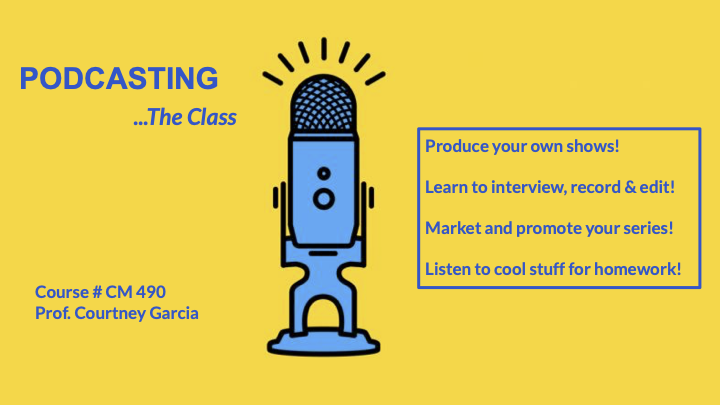
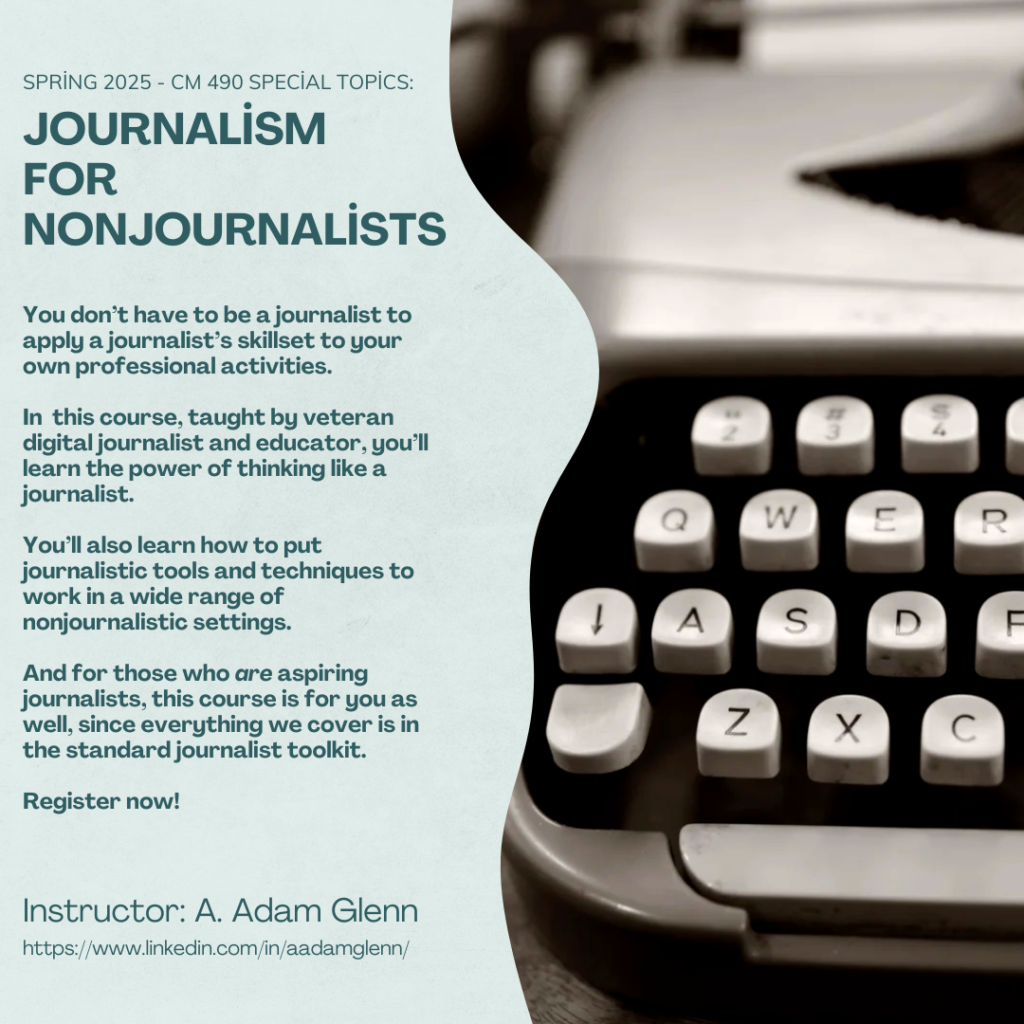
For CM 490, you have the choice between two topics—Introduction to Podcasting, and Introduction to Journalism (aka “Journalism for Non-Journalists”). Both will provide you with strong knowledge of each field, and equip you with durable skills that are transferable across a range of professional contexts.

CM 499: Capstone

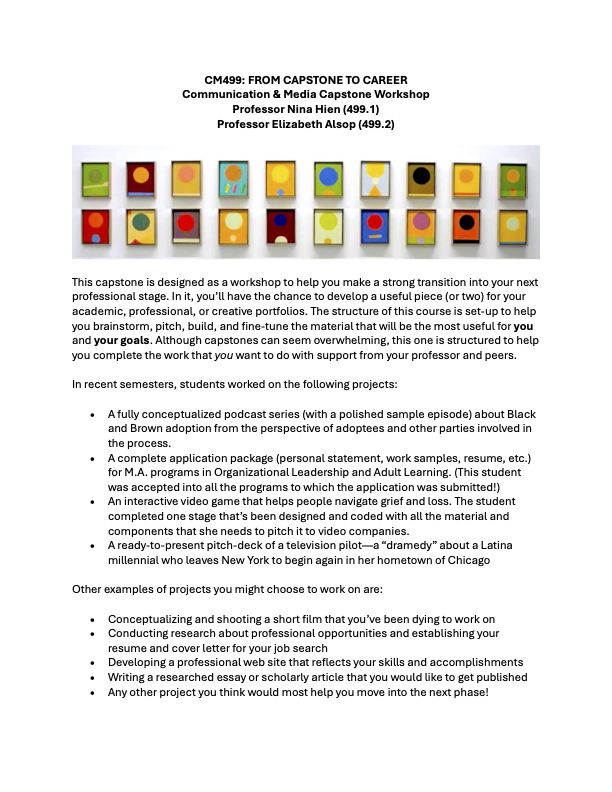
For CM 499, you can choose between Capstone to Career—a workshop class that allows you to produce a polished piece of work for your academic, creative, or professional portfolio—and Engagement Marketing, a more independently structured class focused on marketing.