a collection of resources written by your professors to help you succeed in your classes

Category: Writing & Research (Page 2 of 3)

Identifying types of sources

By Kate Moss, Ph.D, Doctoral Lecturer and Full-time Faculty, General Education & BA in Liberal Studies 
Writing Fellows (WAC) and Tutoring Coordinator

These resources will help you identify different types of sources:

(Note that while these resources direct you to the Cornell Librarians, our own Newman Library Reference librarians provide the same types of assistance – find out how to get in touch in Learning Resources: Get help from the Newman Librarians below.)

Mindful writing Q&A

By Tara Pauliny, Ph.D, Faculty, General Education

Q&A

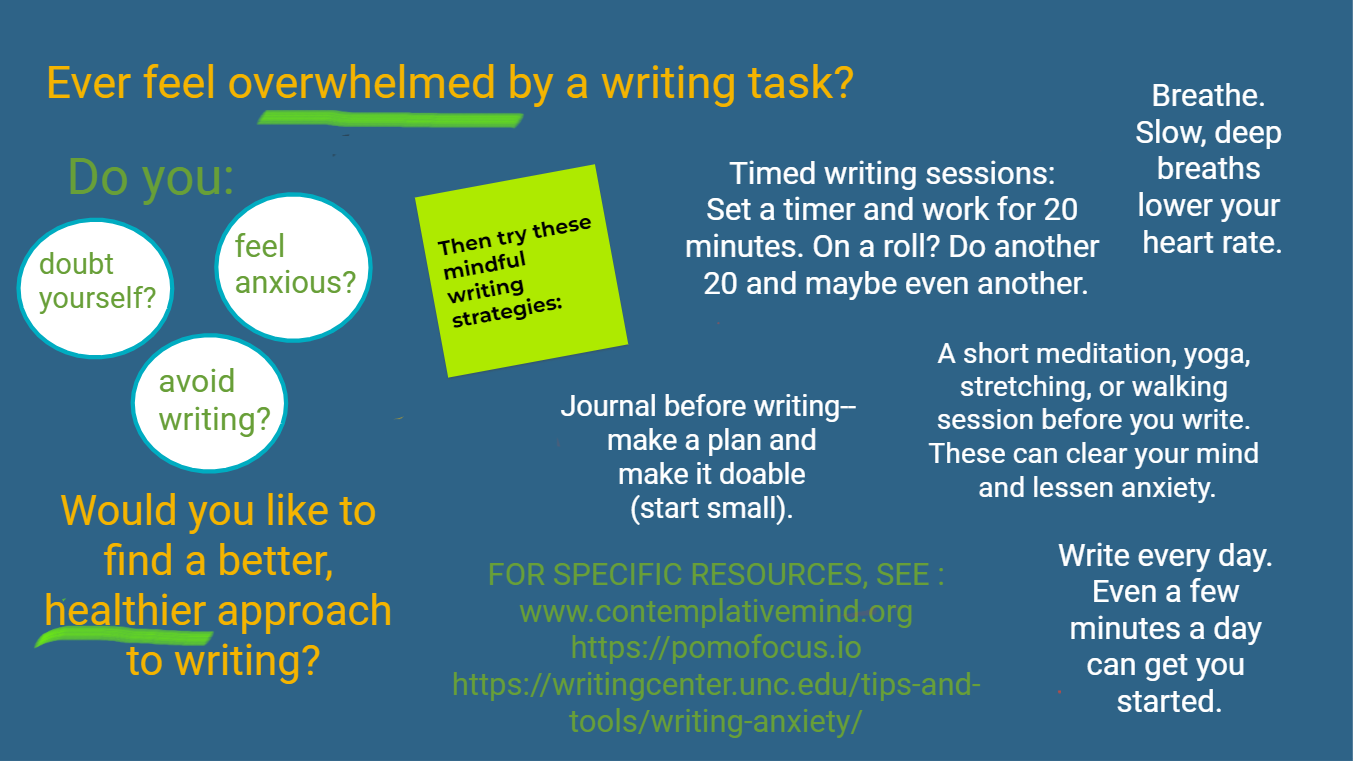
  • Do you ever feel overwhelmed or anxious when presented with a writing task?
  • Do you ever procrastinate or avoid a writing assignment?
  • Do you ever doubt your abilities as a writer or give up before you’ve even started?

If you answered YES, to any of these questions, mindful writing strategies might be helpful to you.

Q: What is mindful writing?

A: Mindful writing is when you apply the practices and approaches of mindfulness to your writing. 

Q: What are “mindful practices”?

A: Mindful practices are activities that encourage your mind and nervous system to slow down and calm down. They can include things like meditation, yoga, timed writing, and self-reflection. 

Q: How can these help my writing?

A: If you are someone who gets anxious around writing or avoids it, mindful practices might help you be less stressed when writing and they might help you get started on a project earlier. They can also help you stay focused as you work and to work consistently and with less distress. 

Q: How do I get started?

A: First, identify what your writing challenges are. Do you put off writing tasks? Do you find yourself distracted when you are writing or do you have trouble concentrating? Are you plagued by thoughts of self-doubt? See if you can identify how you respond to a writing task and make a note of this.

Q: What’s next?

A: Once you have identified your challenge(s), choose a mindful practice that counters this. 

Q: What mindful practices should I try?

A: You have lots of options and can try one or all of these, in any combination. Try them out and see what happens!

  • For restless thoughts/racing mind, try meditation.
    • Start small! Sit comfortably and close your eyes. Breathe slowly in and out and focus on your breathing. When your mind wanders or starts to think about something else, gently remind yourself to focus on your breath. Don’t judge the wandering–just return to your breathing. Try to do this for 1 minute and work your way up to more time.
  • For general anxiety around writing, try breathing exercises.
    • You can simply take a few deep, cleaning breaths or you can do some more focused techniques.
    •  One approach that might balance your emotions is to inhale and exhale for the same amount of time: Sit comfortably and inhale, slowly, through your nose for a count of six. Hold it for a second or two and then exhale, slowly, through your nose, for a count of six. You can try this for less or more time, as is comfortable for you. 
  • For procrastination, try journaling and setting small, clear goals.
    • Before you write or even instead of writing, do the following: jot down how you are feeling and then literally turn the page. Try to leave those feelings on that page and choose a plan for a short writing session.
      • For example, if you are having trouble starting a project, your goal for your first session might simply be to review the assignment and make a list of two things you can do to get started. 
  • For self-doubt, try timed writing sessions.
    • Set a timer for 20 minutes. Do this literally: use your phone or a kitchen timer or download a free timer and set it for 20 minutes. Then, work on your writing project for those 20 minutes–commit to working steadily for that short period of time. When the 20 minutes are up, you can do another 20 minute session or stop. Either way, congratulate yourself–you wrote! 

Q: Do I need to follow these strategies exactly?

A: No, absolutely not! Try any or all of these strategies in any combination, for any reason. See what you like and what works for you. And keep track of your responses so you know what works and what doesn’t.

Q: Any other suggestions?

A: Yes, you can also try these more physically active strategies–some people respond more to movement. Sometimes “getting out of your head” can break the anxiety cycle. Try one of these activities followed by one of the strategies above…

  • Take a yoga class or try a few yoga poses at home.
  • Do a “shake-out”–stand up and shake your limbs, your torso…move around however feels good to you. Try this with and without music. 
  • Put on music and sing along for a few minutes.
  • Go outside and get some fresh air and/or sunshine

Q: These are interesting ideas. Where can I find more information?

A: There are lots of free resources available online as well as some you can purchase. Here are some to get you started:

Free online resources:

Resources you can purchase:

  • Boice, Robert. How Writers Journey to Comfort and Fluency: A Psychological Adventure Praeger: Westport, Connecticut, 1994.
  • Moore, Dinty W. The Mindful Writer. Wisdom Publications: Somerville, MA. 2016. 
  • Stahl, Bob and Elisha Goldstein. A Mindfulness-Based Stress Reduction Workbook. New Harbinger Publications, Inc: Oakland, CA, 2010.
  • There are many other authors who write about these issues; you might look for work on mindfulness and meditation by Pema Chodron, breathing by Doug Keller, and self-acceptance by Jessamyn Stanley.

Revision and editing

By Tara Pauliny, Ph.D, Faculty, General Education

What is the difference between revision and editing?

The difference between revision and editing is a matter of scope: when we edit, we are looking at the so-called “local” aspects of your paper such as grammatical errors, misspellings, formatting concerns, and adherence to citation rules. On the other hand, revision is more “global”; when revising, we are thinking about larger issues in the paper such as the thesis, the evidence we use, how we’ve structured the paper, etc. For more about writing and revision, see this chapter by Ellen Carillo: Writing and Revising the Academic Projects

When should I revise and when should I edit?

While both are essential parts of the writing process, revision should happen before editing. Editing is typically the last stage of the process–edit (also called proofreading) once all the revisions are done. It is also a good idea to let some time pass between revising and editing so you can see the paper with fresh eyes.

How do I revise?

One method of revision is to have someone else read your paper and offer you global comments (not editorial comments such as where you made spelling or grammatical errors) and then use these comments as a guide to help you make changes to your paper.** You might go to a writing tutor for this kind of feedback or ask someone whose writing you admire. Another way to revise is for you to revisit the assignment prompt and then review your paper to see what aspects you might change to address the prompt more clearly. Remember, when you revise, focus on the larger issues of the paper such as how well you are responding to the prompt, if you have a clear purpose or thesis, how you have organized the paper, how well you utilize evidence and analysis, etc. Don’t get bogged down with sentence-level issues–save those for your final step: editing. 

**Also: this is why so many writing classes incorporate peer review–it offers you the opportunity to get feedback on your writing and to then use that feedback to revise your paper. If you are given this opportunity in your classes, take it! For more information about peer review and how to participate in it effectively, see these resources: Peer Review from the WAC Clearinghouse and Making Peer Review More Than a Waste of Time by Jason Roberts.

I’m still confused–can you say more about revision?

Another way of thinking about revision is as re-seeing. Try to look at your paper as a reader rather than as the writer. Imagine that you are seeing it for the first time–what do you notice? What needs to be clarified? What is working well? Consider the assignment prompt and ask yourself: “Does this paper fulfill this prompt? Are there ways it could do this better or more clearly? To read more about writing as revision, see Chris Blanjenship’s essay Writing is Recursive.

Why do I need to revise? Can’t I just write the paper and be done with it?

Talk to any professional writer or writing teacher, and they will tell you that all writing is revision. Writing is a process that includes planning, drafting, revising, rethinking, rewriting, rethinking, and on and on. Depending on the length and depth of a writing project, the process of writing can take a few hours (an important email, for instance), a few days or even weeks (an academic paper, perhaps), or even a few months or years (a book or a dissertation). There is a saying that “all writing is rewriting”; revision is one way to make your writing as successful as it can be. For more on this, see Lisa Bickmore’s essay Revision IS Writing. That is All.

I’m ready to edit–what are some good strategies?

There are lots of effective ways to edit. Here are a few to try:

  • Read your paper backwards: To catch misspellings, extra words, and other minor errors, read your paper backwards. That is, read the last sentence and then the second-to-last, and so on. This helps you avoid “reading over” mistakes since you are reading the sentence out of context and out of order.
  • Keep a running list of the specific kinds of errors you tend to make and then focus on looking for those. Most writers make the same mistakes repeatedly so if you know what these are for you, you can look for them as you review your paper. You can keep a list on your computer or phone and add to it–this will help you recognize your errors, learn how to correct them, and soon you might stop making them at all!
  • Ask someone you trust–who is a strong writer and good with details–to read the first two paragraphs of your paper looking for sentence-level errors. Then, use their comments as a guide to help you edit the rest of your paper. 
  • Read your paper out loud. If you are a native speaker of the language you are writing in, try reading the paper out loud. This often helps you find mistakes.
  • Use resources* when you have questions and to double-check your work. This is especially true for when you proofread your in-text citations and your references. For example, if you are writing the paper in APA format, don’t rely on memory. Have the guide handy and look up the rules you need to follow. Also, find a resource you like and use it routinely to learn about and check for local errors such as the use of commas, capitalization rules, run-on sentences and sentence fragments, etc. The more you use a guide, the more you will become familiar with it and if you remind yourself of the rules of usage, you will start to use them automatically.
  • You can also see this resource from the WAC Clearinghouse: Editing and Proofreading Strategies
  • * Review these resources, find the one you like the most, and bookmark it:

Sentence clarity: run-on sentences, subject-verb agreement, and sentence fragments

By Virginia “Ginny” Gilroy, MA, Full-time Faculty and Lecturer, General Education

Avoiding run-on sentences

If you’re a beginning college writer and you’re writing very long sentences, chances are you have a run-on sentence. A sentence is a group of words with one subject and one verb that expresses a complete thought. If you are expressing more than one thought or idea in the same sentence, you have a run-on sentence. 

The way to avoid run-on sentences is to be sure that each sentence is constructed around one independent clause that has a subject and a verb. Everything else in the sentence should describe, define, and support that main idea.

As a college writer, you probably don’t want a paper that is full of simple sentences, though it would be grammatically correct. To go beyond the basics, include dependent clauses and phrases that support the organizing idea of your sentence. As you build your sentence, be sure that all clauses add something to the main clause, but don’t overdo it. For a more in-depth exploration of complex sentence structures, take a look at the post from the Writing Center at University of North Carolina at Chapel Hill.

Helpful link:

https://writingcenter.unc.edu/tips-and-tools/sentence-patterns/

Subject/verb agreement

When creating a grammatically correct sentence, the subject and verb in the sentence must agree in number. If you have ever learned a second language, you were taught to conjugate verbs, which is basically the same principle behind subject/verb agreement. To achieve subject/verb agreement, ask yourself how many things or people act in the sentence. If the action of the verb applies to one person or thing, the verb is singular. If the action of the verb is being performed or embodied by more than one person or thing, the verb will be plural.

Examples:

  • The duck quacks at sunrise.
  • All ducks quack.

Note that singular verbs, ironically have an s at the end.

Subject/verb agreement with pronouns. In direct contradict the rule stated above third person singular pronoun subjects require verbs that end in s.

 Singular SubjectsPlural Subjects
First personI learnWe learn
Second personYou learnYou all learn
Third personHe learns. She learns. The girl learns.*They learn

The problematic pronouns: As we saw in the chart above pronouns don’t like to follow the rules. The following is a quick list of some of the more challenging pronouns and the verb forms that will create agreement.

  • Anyone, anybody, anything, everyone, everybody, everything, someone, somebody, something, either, neither, another, several. – are all collective pronouns acting as one and require a singular verb.

Many, both, few – require a plural verb.

  • All, most, any, some, none — can be either plural or singular. In this case check the prepositional phrase for the required verb form.

Examples:

  • Most of that hole was dug by me.
  • Most of the holes were dug by team two.

There are some tricky exceptions to the rules above cited. Focus on memorizing the specific special cases and exceptions that you most often encounter in your writing. Master those and keep a reference guide handy to look up those cases you’re unsure of. Be wary of grammar checkers. With complex sentences, they are no better at picking out the real subject of the sentence than you are.

To go beyond the basics and be sure to check out the University of Wisconsin’s website for more exceptions to the basic rule of agreement. https://writing.wisc.edu/handbook/grammarpunct/subjectverb/

If you would like some online practice with subject/verb agreement, visit this link to the Excelsior College Writing Lab: https://owl.excelsior.edu/writing-refresher/grammar-refresher/subject-verb-agreement/

Transition between paragraphs

By Virginia “Ginny” Gilroy, MA, Full-time Faculty and Lecturer, General Education

How can I transition smoothly between paragraphs?

Writers begin new paragraphs to introduce new ideas. Transitions indicate how those ideas are related. To write a smooth transition, tell the reader how the new idea relates to the previous idea.

Transitional words and phrases are helpful for the college writer. The Writing Center at the University of Wisconsin has compiled a list of helpful transitions. Notice how transitional words and phrases are grouped by their function. Some transitions add information to a previous idea, while others can contrast or clarify. If you’re stuck in your writing and need new ideas reviewing a list of transitions may even inspire new ideas.

University of Wisconsin: Transitional Words and Phrases: https://writing.wisc.edu/handbook/style/transitions/

Another way to write a smooth transition is by using the known/new method—link what the reader already knows with new information using the keyword link. A keyword link echoes what the reader knows from the previous paragraph to the new idea or information being discussed in the next paragraph.

For an example of how to create transitions using the known/new method, see this video: https://youtu.be/6gku-vSf9Rk (start at 3:00)

For a concise summary of the known/new method, follow the link below to the George Mason University Writing Center: https://writingcenter.gmu.edu/guides/improving-cohesion-the-known-new-contract

The University of North Carolina at Chapel Hill offers students a thorough overall review of transitional expressions and techniques for writing transitions. https://writingcenter.unc.edu/tips-and-tools/transitions/

Thesis statements

By Giordana Fiori

What is a thesis ?

A thesis must be a statement that people could reasonably have differing opinions on. If your thesis is something that is generally agreed upon or accepted as fact then there is no reason to try to persuade people.

A thesis is a road map for the paper; in other words, it tells the reader what to expect from the rest of the paper.

Example of a thesis: In Huckleberry Finn, Mark Twain develops a contrast between life on the river and life on the shore.Source: https://writingcenter.unc.edu/tips-and-tools/thesis-statements/

How long should a thesis statement be?

A thesis is usually a single sentence near the beginning of your paper (most often, at the end of the first paragraph) that presents your argument to the reader. The rest of the paper, the body of the essay, gathers and organizes evidence that will persuade the reader of the logic of your interpretation.

Source: https://writingcenter.unc.edu/tips-and-tools/thesis-statements/

How narrow or broad should a thesis be?

The thesis needs to be narrow Although the scope of your paper might seem overwhelming at the start, generally the narrower the thesis the more effective your argument will be. Your thesis or claim must be supported by evidence. The broader your claim is, the more evidence you will need to convince readers that your position is right.

Example of a broad thesis:

Drug use is detrimental to society.   ❌  Too broad to argue, too general

Example of a narrow thesis:

Illegal drug use is detrimental because it encourages gang violence.   ✅Narrow, manageable topic

Source: https://owl.purdue.edu/owl/general_writing/academic_writing/establishing_arguments/index.html

Which kinds of thesis exist?

Typically, there are four kinds of claims:

Claims of fact or definition: These claims argue about what the definition of something is or whether something is a settled fact.

Example: While some pundits have framed a four-year college education as something necessary for adult success, this notion should not be treated as a given.

Claims of cause and effect: These claims argue that one person, thing, or event caused another thing or event to occur.

Example: Federal student loan policies have contributed to widespread growth in college tuition.

Claims about value: These are claims made of what something is worth, whether we value it or not, how we would rate or categorize something

Example: The student debt crisis is one of the most serious problems facing the country today.

Claims about solutions or policies: These are claims that argue for or against a certain solution or policy approach to a problem.

Example:  Rather than encouraging all students to attend four-year colleges, we should instead emphasize the validity of two-year colleges, technical schools, and trade schools as well.

Source: https://owl.purdue.edu/owl/general_writing/academic_writing/establishing_arguments/index.html

How do I know which kind of claim is right for my thesis?

Which type of thesis or claim you use for your argument will depend on your position and knowledge of the topic, your audience, and the context of your paper. You might want to think about where you imagine your audience to be on this topic and pinpoint where you think the biggest difference in viewpoints might be.

Source: https://owl.purdue.edu/owl/general_writing/academic_writing/establishing_arguments/index.html

Where in the paper should the thesis statement be?

The thesis statement usually appears at the end of the first paragraph of a paper.

Source: https://owl.purdue.edu/owl/general_writing/academic_writing/establishing_arguments/index.html

How do I approach writing a thesis?

  1. Determine what kind of paper you are writing:
    • An analytical paper breaks down an issue or an idea into its component parts, evaluates the issue or idea, and presents this breakdown and evaluation to the audience.
    • An expository (explanatory) paper explains something to the audience.
    • An argumentative paper makes a claim about a topic and justifies this claim with specific evidence. The claim could be an opinion, a policy proposal, an evaluation, a cause-and-effect statement, or an interpretation. The goal of the argumentative paper is to convince the audience that the claim is true based on the evidence provided.
  2. In developing a sophisticated thesis, your goal should be to create a concise and impactful statement which grabs the reader’s attention as a uniquely intriguing argument. Thus three important questions to ask yourself are:
    • What is my claim?
    • How is my claim supported?
    • So what/why does my claim matter?
  3. Your topic may change as you write, so you may need to revise your thesis statement to reflect exactly what you have discussed in the paper.

Source: https://wp.ucla.edu/wp-content/uploads/2016/01/UWC_handouts_What-How-So-What-Thesis-revised-5-4-15-RZ.pdf

How to construct paragraphs

By Silvan Spicer

Why do I need to split my paper into paragraphs?

Paragraphs help readers visualize the order and structure of your argument. If your paper is one long paragraph, it can be hard to tell where one idea stops and another starts. Separating your ideas into distinct paragraphs will improve the organization, flow, and readability of your papers.

How should I format my paragraphs?

  • For APA style, the first line of each paragraph should be indented.
  • Each paragraph starts on a new line.
  • You should not add any extra spaces after each paragraph.
  • Always double check your assignment to see if your professor wants you to format paragraphs differently, since these standards might vary depending on your discipline and/or the purpose and audience of your assignment.
  • Note: In many online sources you may see formatting that is optimized for digital and mobile reading. This might include spaces between paragraphs, no indents, etc. However, this is currently not the best practice for academic essays.

Correct Paragraph Format: 

Lorem ipsum dolor sit amet, consectetur adipiscing elit, sed do eiusmod tempor incididunt ut labore et dolore magna aliqua. Lacus vestibulum sed arcu non. 

Donec massa sapien faucibus et. Tortor aliquam nulla facilisi cras fermentum odio eu feugiat pretium. Lectus nulla at volutpat diam ut venenatis tellus. 

Incorrect Paragraph Format: 

Lorem ipsum dolor sit amet, consectetur adipiscing elit, sed do eiusmod tempor incididunt ut labore et dolore magna aliqua. Lacus vestibulum sed arcu non.

Donec massa sapien faucibus et. Tortor aliquam nulla facilisi cras fermentum odio eu feugiat pretium. Lectus nulla at volutpat diam ut venenatis tellus.

In the correct example, each new paragraph is indented, and there are no extra spaces at the end of each paragraph.

What are the essential parts of a body paragraph?

A paragraph should have the same structure as your paper does, just on a smaller scale. This includes a beginning, middle, and end. These three parts can be summarized a bit jokingly as “Say what you’re going to say,” “Say it,” and “Say what you just said.” In other words:

  • The beginning includes a transition from your previous paragraph and your topic sentence. The topic sentence needs to clearly tie back to the thesis, or overall argument, of your paper as a whole. It will show how this one piece of the puzzle fits into your larger argument.
  • The middle includes the “meat” of your paragraph, including details that support your argument using explanations, evidence, analysis, etc.
  • The end includes a concluding statement that sums up the main purpose or idea of the paragraph.

How are body paragraphs different from introduction and conclusion paragraphs?

Body paragraphs contain the “meat” of your paper – a.k.a. all of the evidence, details, and logic you will use to support your main argument. Introduction and conclusion paragraphs are different because they deal with the overall argument of your paper as a whole, while body paragraphs focus on individual topics, points, or subtopics that tie into your overall argument.

What should a body paragraph do?

Each body paragraph should have one main idea. 

It might be helpful to think of each body paragraph having its own “purpose,” based on your argument and the points you are trying to make. Here are some of the possible things your body paragraphs can do (This is not an exhaustive list!):

  • Narrate: Tell a story about something. You might narrate the story of how a certain law or policy affected someone’s life.
  • Describe: Give details about something. You might describe how a work of art looks in person.
  • Explain: Tell your audience what something means or how it functions. You might explain the process of cell division.
  • Illustrate: Give examples to support an idea. You might illustrate the impacts of climate change with examples of different climate events.
  • Define: Give a definition of a concept. You might define the word “technology” so your audience understands how you are using it in your paper.
  • Analyze: Break down a topic into smaller parts to show how it works. You might analyze affordable housing laws/policies in New York City.
  • Synthesize: Bring together different ideas/topics to make your own argument based on their interactions and connections. You might synthesize data from multiple reports on mental health to make a point about current rates of mental illness.

Compare/contrast: Show how one thing is similar/different to another thing. You might compare and contrast the way that different news sites talk about the same current event.

How long should my paragraphs be?

There is no “required” length for your paragraphs, but there are some ways to tell if your paragraphs may be too short or too long.

Your paragraph might be too short if…

  • It does not have an adequate beginning, middle, and end
  • It does not have at least one sentence serving as a topic sentence, one sentence serving as a concluding sentence, and at least a couple of sentences that explore the ideas in your paragraph
  • When you reread it, it doesn’t seem like it is making a full or complete point

Your paragraph might be too long if…

  • It has multiple main ideas
  • It talks about more than one central topic
  • It goes on for several pages
  • When you reread it, you can’t figure out what the paragraph is about because there are several things it seems to be about

How can I revise/edit my paragraphs?

One good way to revise your paragraph is to do a reverse outline. When you do this, you read over your paragraph and try to see if it is clear what the paragraph’s main idea is and how that main idea supports your thesis/overall argument. A reverse outline helps you analyze the structure of your paper after you’ve written it, rather than before.

If your paragraph seems to have multiple main ideas, you might want to split it into multiple paragraphs – one for each main idea.

If your paragraph seems like it doesn’t make a full or complete point, that might be a sign to either get rid of it (if it doesn’t tie back to your thesis), or add more to it (if it does tie back to your thesis).

What are some other resources on constructing good paragraphs?

How to use quotations effectively

By Silvan Spicer

When should I use direct quotations?

  1. When the wording in your source is unique or important. If you don’t think you could capture the main idea of the passage if you were to paraphrase or summarize it, it might be a good idea to quote the passage directly. 
  2. When there are specific numbers or data that you need to report in your paper.

Example

Leveille-Tulce (2021) describes mentoring as, “a modality that can help students overcome barriers that hinder their power to excel in their programs and as professionals in the field” (para. 1).

Since this is a definition, the wording is important!

Why should I use direct quotations in my writing?

  • To help support your own ideas.
  • As examples.
  • As evidence.
  • To illustrate your own ideas, NOT to substitute for them. In other words, your central ideas should be stated by you, not your sources.

Example  

One nursing program with a focus on diverse mentoring initiatives is CUNY SPS’s nursing program. It houses the Black Male Initiative, “which was designed to level the playing field of inequity and inequality in higher education” (Leveille-Tulce, 2021, para. 4). 

Notice how the first sentence introduces the student’s idea, while the second sentence uses a quotation to help support that idea.

What kind of punctuation should I use when quoting someone?

  1. Direct quotes should be signaled using quotation marks. (“…”)
    • Incorrect ❌: Leveille-Tulce (2021) says that This decision was spearheaded by the need to provide support to adult students who very often are juggling school with full-time work and family, in addition to other life responsibilities” (para. 5).
    • Correct : Leveille-Tulce (2021) says that, “this decision was spearheaded by the need to provide support to adult students who very often are juggling school with full-time work and family, in addition to other life responsibilities” (para. 5).
    • In the correct example, double quotes are placed at both the beginning and end of the quote.
  2. If you use a parenthetical citation at the end of a sentence, the ending punctuation goes outside of the quote, after the citation. 
    • Incorrect ❌: The program “uses ‘a peer-to-peer mentoring model.’” (Leveille-Tulce, 2021, para. 4)
    • Correct : The program “uses ‘a peer-to-peer mentoring model’” (Leveille-Tulce, 2021 para. 4).
    • In the correct example, the period is placed after the citation, not within the quote.
  3. If your quote is introduced in the middle of a sentence, don’t capitalize the first word.
    • Incorrect ❌: Leveille-Tulce (2021) says that, “This decision was spearheaded by the need to provide support to adult students who very often are juggling school with full-time work and family, in addition to other life responsibilities” (para. 5).
    • Correct : Leveille-Tulce (2021) says that, “this decision was spearheaded by the need to provide support to adult students who very often are juggling school with full-time work and family, in addition to other life responsibilities” (para. 5).
    • In the correct example, the first word of the quotation isn’t capitalized.
  4. For a quote within a quote, the interior quote should be signaled using single quotation marks. (‘…’)
    • Incorrect ❌: The program “uses “a peer-to-peer mentoring model”” (Leveille-Tulce, 2021, para. 4).
    • Correct : The program “uses ‘a peer-to-peer mentoring model’” (Leveille-Tulce, 2021, para. 4).
    • In the correct example, single quotation marks are used to signal the quote within the quote. 
  5. Every opening quotation mark must have a closing quotation mark, so that your readers know where the other person’s words end and where yours begin.
    • Incorrect ❌: Leveille-Tulce (2021) says that, “this decision was spearheaded by the need to provide support to adult students who very often are juggling school with full-time work and family, in addition to other life responsibilities (para. 5).
    • Correct ✔: Leveille-Tulce (2021) says that, “this decision was spearheaded by the need to provide support to adult students who very often are juggling school with full-time work and family, in addition to other life responsibilities” (para. 5).
    • In the correct example, both the opening and closing quotation marks are present.
  6. When your sentence continues after the material you are quoting, use commas to signal the end of the quote.
    • Incorrect ❌: The program “uses ‘a peer-to-peer mentoring model’” which is an important distinction from other models (Leveille-Tulce, 2021, para. 4).
    • Incorrect ❌: The program “uses ‘a peer-to-peer mentoring model.’” which is an important distinction from other models (Leveille-Tulce, 2021, para. 4).
    • Correct ✔: The program “uses ‘a peer-to-peer mentoring model,’” which is an important distinction from other models (Leveille-Tulce, 2021, para. 4).
    • In the correct example, a comma is used at the end of the quotation and before the rest of the sentence.
  7. To add emphasis in a quote, use italics, and write “emphasis added” in brackets ([…]) immediately after the emphasized words, within the quote itself.
    • Incorrect ❌: The program “uses ‘a peer-to-peer mentoring model’” (Leveille-Tulce, 2021, para. 4).
    • Correct ✔: The program “uses ‘a peer-to-peer [emphasis added] mentoring model’” (Leveille-Tulce, 2021, para. 4).
    • In the correct example, the added emphasis is signaled immediately after the emphasized words.

How should I format direct quotes?

  • If they are less than 40 words (according to APA style): copy them directly into your body paragraphs, using correct punctuation. 
  • If a quote is longer than 40 words, it should be a block quote. To make a quote a block quote, you start the quote on a new line. The entire quote should be indented, and you don’t use quotation marks with it. Introduce the quote using a colon. 

Block Quote Example

Leveille-Tulce (2021) continues by saying:

Although all the mentors are currently CUNY SPS nursing faculty who volunteered to participate, mentors can also be professional nurses outside of the program. Careful measures are taken so as not to pair students to faculty who teach them. The hope is for students to use this resource for career guidance, confidence building, and collegial support. (para. 5)

How do I introduce a quote?

You should introduce every quote you use. A quotation should NEVER stand alone as its own sentence. 

One good way to introduce a quote is to give the reader some of the context they need to know to understand the quote.

  • Who said it?
  • How does it connect to your overall paper topic and/or the subtopic you’re currently focusing on? 

Incorrect

Leveille-Tulce (2021) describes mentoring. “A modality that can help students overcome barriers that hinder their power to excel in their programs and as professionals in the field” (para. 1).

Correct

Leveille-Tulce (2021) describes mentoring as “a modality that can help students overcome barriers that hinder their power to excel in their programs and as professionals in the field” (para. 1).

In the correct example, the quotation is integrating into an existing sentence instead of standing alone as its own sentence.

How do I omit part of a direct quote?

Use ellipses. (…) Simply replace the part of the quote you want to remove with ellipses. 

Example

According to Leveille-Tulce (2021), “mentoring also aligns with the CUNY SPS nursing program’s mission to…excel in the profession of nursing” (para. 2).

How do I effectively explain, clarify, and/or interpret a direct quote I’ve used in my paper?

A good way to think about the direct quotations you use in your paper is to use a “sandwich” model. Your quote should be “sandwiched” between important pieces of context. 

  1. First piece of context: Includes any introductory information your audience needs to know to understand the quote. 
  2. Second piece of context: Usually comes after the quotation, and explains how the quote is relevant to and supports your argument, as well as how this information connects to your next point.

Example

One nursing program with a focus on diverse mentoring initiatives is CUNY SPS’s nursing program. It houses the Black Male Initiative, “which was designed to level the playing field of inequity and inequality in higher education” (Leveille-Tulce, 2021, para. 4). This kind of diversity-focused mentorship helps increase access to resources.

The first and second sentences give the reader introductory context for the quote, and then after the quote, the third sentence adds on more context to help readers understand how the quote fits into their overall argument.

What kind of citation do I need to include with a direct quote?

  1. An in-text citation
  2. A bibliography or works cited entry at the end of your paper

Make sure to follow the citation style that is being used in your course. This example uses APA format. If your instructor wants you to use a different citation style, you can find guides to different citation styles here: https://owl.purdue.edu/owl/research_and_citation/resources.html

In-text Citation Examples

One nursing program with a focus on diverse mentoring initiatives is CUNY SPS’s nursing program. It houses the Black Male Initiative, “which was designed to level the playing field of inequity and inequality in higher education” (Leveille-Tulce, 2021, para. 4). 

Leveille-Tulce (2021) describes mentoring as, “a modality that can help students overcome barriers that hinder their power to excel in their programs and as professionals in the field” (para. 1).

Works Cited Entry Example Leveille-Tulce, A. M. (2021, November 23). Mentoring: A CUNY School of Professional Studies Nursing Student’s Power Enhancer. Daily Nurse. Retrieved February 2, 2022, from https://dailynurse.com/mentoring-a-cuny-school-of-professional-studies-nursing-students-power-enhancer/

This FAQ uses examples from the following source:

Leveille-Tulce, A. M. (2021, November 23). Mentoring: A CUNY School of Professional Studies Nursing Student’s Power Enhancer. Daily Nurse. Retrieved February 2, 2022, from https://dailynurse.com/mentoring-a-cuny-school-of-professional-studies-nursing-students-power-enhancer/ 

All of the examples in this FAQ use APA format. If your instructor wants you to use a different citation style, you can find guides to different citation styles.

Resources for Incorporating Direct Quotes:

How to paraphrase

By Kate Moss, Ph.D, Doctoral Lecturer and Full-time Faculty, General Education & BA in Liberal Studies
Writing Fellows (WAC) and Tutoring Coordinator

When you use information from a source, you may do one of three things:

  • Summarize the information and cite the source;
  • Quote the source directly and cite the source; or
  • Paraphrase the material thoroughly and cite the source.

Paraphrasing is an important skill to master as you will use it in any writing that uses source material.

To paraphrase sufficiently, you need to both:

  • Put the author’s ideas into your own words, and
  • Change the structure of the sentence or passage, so you are not copying that.

The most common mistake we see with paraphrasing is not paraphrasing sufficiently.  It’s very important that you thoroughly paraphrase in order to avoid academic integrity issues.

Useful links:

  • “Paraphrasing” from Excelsior OWL explains why paraphrasing is important and gives examples of how to put source material into your own words.
  • “Paraphrasing Structure” from Excelsior OWL explains why it’s important to change the structure of the sentence or passage when paraphrasing, and how to do this.
  • In “Finding, Using and Citing Sources in APA Format” (2021), SPS Writing Fellow Kajal Patel gives tips on paraphrasing and shares examples of insufficiently and sufficiently paraphrased source material. (Note this is a recording of a live webinar so there is reference to polls.) You can watch just the relevant section beginning at 31:07 here.
  • This “Paraphrasing Activity” from Excelsior OWL quizzes you briefly on your ability to recognize passages which have been thoroughly paraphrased to change their words and structure.

Finding reputable scholarly sources

By Giordana Fiori

Credible sources vs scholarly sources: what is a scholarly source?

  • Credible sources are popular sources, such as newspapers and magazines, government websites, or websites of well-respected associations.
  • Scholarly sources are written by highly-qualified researchers and have a thorough publication process. Scholarly sources often have a specific audience in mind, most likely other experts in the particular field of study.
    • Peer reviewed scholarly sources: if a journal is peer reviewed it means that scholars have reviewed the articles and have decided that the sources are reliable, the research is sound, and the writing is solid.

Where do I find reputable scholarly sources?

Public libraries or university libraries have subscriptions to databases where these sources are housed:

  • CUNY SPS has access to the Baruch College Newman library: Search the library system’s database through CUNY One Search (you can find articles on google scholar too, but they are free on the library website!).
    1. Click on one search link.
    2. Type in your keywords: too many results?
    3. Narrow it down using the sidebar on the right.
    4. Email the source to yourself or download a pdf.

What is a specialized database?

A specialized database – often called a research or library database – allows targeted searching on one or more specific subject areas (i.e., engineering, medicine, Latin American history, etc.), for a specific format (i.e., books, articles, conference proceedings, video, images), or for a specific date range during which the information was published. Most of what specialized databases contain can not be found by Google or Bing.

When should I use a specialized database?

Specialized databases are especially helpful if you require a specific format or up-to-date, scholarly information on a specific topic. Many databases are available both in a free version and in a subscription version. Your affiliation with the Newman library grants you access to member-based services at no cost to you.

What is a database scope?

Information about the specific subject range, format, or date range a particular specialized database covers is called its scope. A specialized database may be narrow or broad in scope, depending on whether it, for instance, contains materials on one or many subject areas.

How do I search a database effectively?

  • Key words: Databases are better searched by beginning with only a few general search terms, reviewing your results and, if necessary, limiting them in some logical way.
  • Limiting your search: Many databases allow you to choose which areas (also called fields) of items to search for your search term(s), based on what you think will turn up documents that are most helpful. For instance, you may think the items most likely to help you are those whose titles contain your search term(s). In that case, your search would not show you any records for items whose titles do not have your term(s). Or maybe you would want to see only records for items whose abstracts contain the term(s).
  • Records and fields: The information researchers usually see first after searching a database is the “records” for items contained in the database that also match what was asked for by the search. Each record describes an item that can be retrieved and gives you enough information so that you can decide whether it should meet your information needs. The descriptions are in categories that provide different types of information about the item. These categories are called “fields.” Some fields may be empty of information for some items, and the fields that are available depend on the type of database.

Which fields are typically available?

A bibliographic database describes items such as articles, books, conference papers, etc. Common fields found in bibliographic database records are:

  • Author.
  • Title (of book, article, etc.).
  • Source title (journal title, conference name, etc.).
  • Date.
  • Volume/issue.
  • Pages.
  • Abstract.
  • Descriptive or subject terms.

Useful links:

Sources:

« Older posts Newer posts »

© 2026 SPS Knowledge Bank

Theme by Anders NorenUp ↑