Category: Writing & Research (Page 1 of 3)
By Judit Török, Ph.D, Professor of Philosophy, General Education
Director, Center for Teaching and Learning at Pratt Institute
You may encounter an assignment in which you are asked to review a classmate’s paper or project and provide feedback. Providing peer feedback to each other in a safe classroom setting can be immensely beneficial for your learning. It helps you develop and value a process-oriented mindset, allows you to put yourself in the shoes of your readers and provides you with practice in collaborating with others. Additionally, peer feedback helps you become a more effective critical reader as you get better at providing and receiving constructive academic and professional feedback. And of course, you can then apply what you are learning to your own work.
Here are some ground rules:
- As a writer: keep an open mind, critically reflect on the feedback you receive, ask follow-up questions if you don’t understand something, and use the feedback to make revisions to your work.
- As a reader providing feedback: start with a positive statement, don’t be afraid to provide suggestions but be supportive; and remember to be concrete and detailed.
Step 1.
- Begin with a positive statement on your classmate’s work. Point out what you think they did right.
Step 2.
- Talk about the clarity of the overall paper, here are some sample ideas to address:
- Could the readability, clarity, or style of this paper be improved? How?
- Does it have a clear thesis statement?
- Does each paragraph of this paper logically progress from the former ones? Why or why not?
- How clearly does the author express his or her ideas?
- Do you feel this paper relies on evidence, or on opinion or intuition? If the latter, cite examples of where this paper relies on opinion and intuition and give suggestions as to how the writer can write more objectively.
- How smoothly does this paper integrate examples into its own argument? Does it clearly illustrate connections between the evidence it cites and the ideas they support, or does it merely assume them? Explain.
Step 3.
- Finally, add a couple feedback statements that you believe will help your classmate improve their drafts.
- Feel free to use the following sentence starters:
- The most important thing I think you can do to improve this draft is…because…
- One sentence that was not specific enough was… because…
- One idea that you have not fully illustrated with a specific example is…
- I think you could have written more about…. because…
- I wasn’t sure what you meant when you…. because…
- I don’t think you needed to include… because …
- I think you could have used transitional words in the following places…
- One type of grammar and/or punctuation error I noticed in your draft was… Here is one example of this type of error…
Download a handout:
By Kate Moss, Ph.D, Doctoral Lecturer and Full-time Faculty, General Education & BA in Liberal Studies
Writing Fellows (WAC) and Tutoring Coordinator
Putting references into APA 7 style (or another citation style) can be time consuming, and you may want to take advantage of citations generated automatically by the library databases or a citation generator on the Internet. Using citation generators can make your job easier as long as you know how to use them correctly and do so with caution.
Citation generators – even the ones used by the Newman Library databases — often produce errors. It’s your job to double check the citation which is generated by looking at the source and to make any needed corrections.
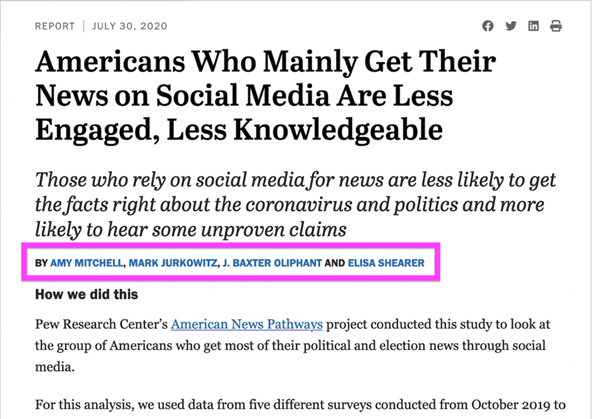
For example, here is an article from Pew Research: “Americans Who Mainly Get Their News on Social Media Are Less Engaged, Less Knowledgeable”. The four authors are listed above the article as: Amy Mitchell, Mark Jurkowitz, J. Baxter Oliphant and Elisa Shearer:
At the time of this writing (12/2023), I put the URL of this article into Chegg’s Citation Machine, and it produced this citation in APA style:
Mitchell, A. (2020, July 30). Americans who mainly get their news on social media are less engaged, less knowledgeable. Pew Research Center’s Journalism Project. https://www.pewresearch.org/journalism/2020/07/30/americans-who-mainly-get-their-news-on-social-media-are-less-engaged-less-knowledgeable/
This citation is almost correct. However, it omits three of the listed authors. In APA 7 style References lists, you need to list all of the authors for a work, if there are fewer than twenty.
Since the generated citation is wrong, you would need to correct it as follows:
Mitchell, A., Jurkowitz, M., Oliphant, J.B., & Shearer, E. (2020, July 30). Americans who mainly get their news on social media are less engaged, less knowledgeable. Pew Research Center’s Journalism Project. https://www.pewresearch.org/journalism/2020/07/30/americans-who-mainly-get-their-news-on-social-media-are-less-engaged-less-knowledgeable/
When you click the link to copy a citation for a resource you find in the Newman Library, you also need to check it for accuracy, since these automatically-generated citations can also contain errors.
Resources:
- Resources from Purdue OWL and Pine Technical and Community College explain how to cite works with various numbers of authors.
- This resource from Excelsior OWL shows how to cite an article on a website.
By Virginia “Ginny” Gilroy, MA, Full-time Faculty and Lecturer, General Education
Using transitions between sentences in a paragraph.
Transitional words and phrases signal how the ideas in your paragraph are logically connected. Effective transitions build cohesion by telling readers how ideas are relevant to the main topic.
Because all the text in a paragraph is focused on one main idea, use transitional words that describe the connection. Use words that —
- emphasize the main idea: Above all, a key feature, important to note
- offer additional evidence or support for the main idea: In addition, moreover, furthermore
- connect an idea to an example: for example, to illustrate, specifically
Additionally, it can often be effective to further your examples by offering examples that compare and contrast the main point by using the following transitional words:
- To compare ideas: like, by comparison, similar to, in the same way
- To contrast ideas: however, on the other hand, conversely
By Kate Moss, Ph.D, Doctoral Lecturer and Full-time Faculty, General Education & BA in Liberal Studies
Writing Fellows (WAC) and Tutoring Coordinator
- Plagiarism: What it is and How to Recognize it and Avoid it (Indiana University Writing Guide). While not part of the IU tutorial, this source offers examples of improper paraphrasing and ways to avoid plagiarism when using sources.
- Review the six part recording of “How to Find, Use, and Cite Sources in APA Style” from 2022-23 CUNY SPS Writing Fellows Ibtisam Ammouri and Miranda Hajduk below or on YouTube. This popular webinar is offered at SPS every semester. You can click the individual links to watch just one segment, or click the embedded video below to watch the full sequence, which is about 42 minutes.
Note that if you click the embedded video below, the six parts will play one after the other, so be sure and stick around for the entire presentation.
By Kate Moss, Ph.D, Doctoral Lecturer and Full-time Faculty, General Education & BA in Liberal Studies
Writing Fellows (WAC) and Tutoring Coordinator
References Lists and In-Text Citations in APA Format
Here is a list of sources on how to create references lists and in-text citations in APA format.
Resources for creating References Lists in APA style:
- References List (Basic Rules) (Purdue OWL)
- References List (Author/Authors) (Purdue OWL: includes information on dealing with sources that have one, two, or more than two authors, as well as indirect sources)
- References List format for Books (Purdue OWL)
- References List format for Electronic Sources (including web pages, eBooks or electronic journals) (Purdue OWL)
- References List Format for audiovisual material (YouTube video, photograph, etc.) (Purdue OWL)
- How to cite a YouTube video (APA Style Blog: goes into more detail on citing types of videos than the Purdue OWL link above)
Resources for creating in-text citations in APA style:
- In-Text Citations (Basics) (Purdue OWL: includes directions for dealing with short vs. long quotations of 40+ words, which should be block indented)
- In-Text Citations (Author/Authors) (Purdue OWL: includes information on dealing with sources that have one, two, or more than two authors, as well as indirect sources)
By Kate Moss, Ph.D, Doctoral Lecturer and Full-time Faculty, General Education & BA in Liberal Studies
Writing Fellows (WAC) and Tutoring Coordinator
Tips and resources for using quotations/paraphrases:
- Avoiding dropped quotations: Quote Sandwich from St. Louis Community College. Be careful not to place quotations into your writing without introducing or commenting on them. This is called a “dropped quotation”. Consider the three steps of the “quotation sandwich”: introduce the quotation with a signal phrase, then quote, then analyze, comment on or contextualize the quote. (Also see the “APA Signal Phrase” resource below!)
- APA 7 signal phrases for quotes/paraphrases (Antioch College): this PDF handout gives examples of how to use signal phrases to introduce a quotation or paraphrased passage in your writing. Signal phrases also work in MLA style (though the in-text citation will differ).
- Using Quotations (Excelsior OWL)
- Paraphrasing (Excelsior OWL)
By Kate Moss, Ph.D, Doctoral Lecturer and Full-time Faculty, General Education & BA in Liberal Studies
Writing Fellows (WAC) and Tutoring Coordinator
How to Read a Scholarly Article (University of Tennessee-Chattanooga Library, 9 mins., transcript provided)
Despite the title, this video helps you learn to identify scholarly, peer-reviewed journal articles, and gives tips on reading them.
How to Read a Scholarly Article (NCSU Library, 7 mins., transcript provided)
This video goes into more detail about the parts of scholarly, peer-reviewed journal articles, differences among disciplines, and how to approach reading the articles.
By Kate Moss, Ph.D, Doctoral Lecturer and Full-time Faculty, General Education & BA in Liberal Studies
Writing Fellows (WAC) and Tutoring Coordinator
Consider using a free citation manager to keep track of sources for all your college writing assignments. Many people like Zotero: (see Quick Start Guide and Support, or the Newman Library’s Zotero guide). Your entries can include links, details on the source that are needed for citing each item, and even a PDF copy of the source. When it’s time to generate a References list, Zotero does most of the work for you. The Baruch Newman Library also runs regular introductory and advanced Zotero workshops.
By Kate Moss, Ph.D, Doctoral Lecturer and Full-time Faculty, General Education & BA in Liberal Studies
Writing Fellows (WAC) and Tutoring Coordinator
The Newman Library Reference Librarians can help you with quick research questions, or you can make an appointment for a longer research consultation and work on identifying search terms and searching library databases (either in person or by video chat). Day, evening, and weekend appointments are available.
Ask a Librarian (quick questions)
Schedule a Research Consultation (more in depth assistance)